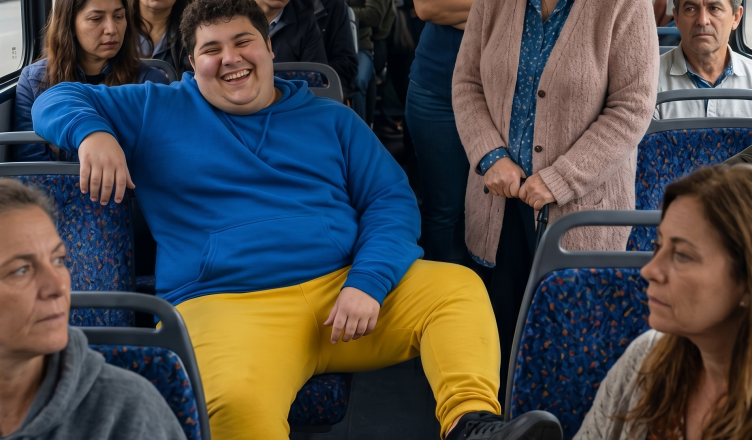
The young man’s words hung in the air like an insult nobody could ignore.
For a moment, the entire bus seemed frozen.
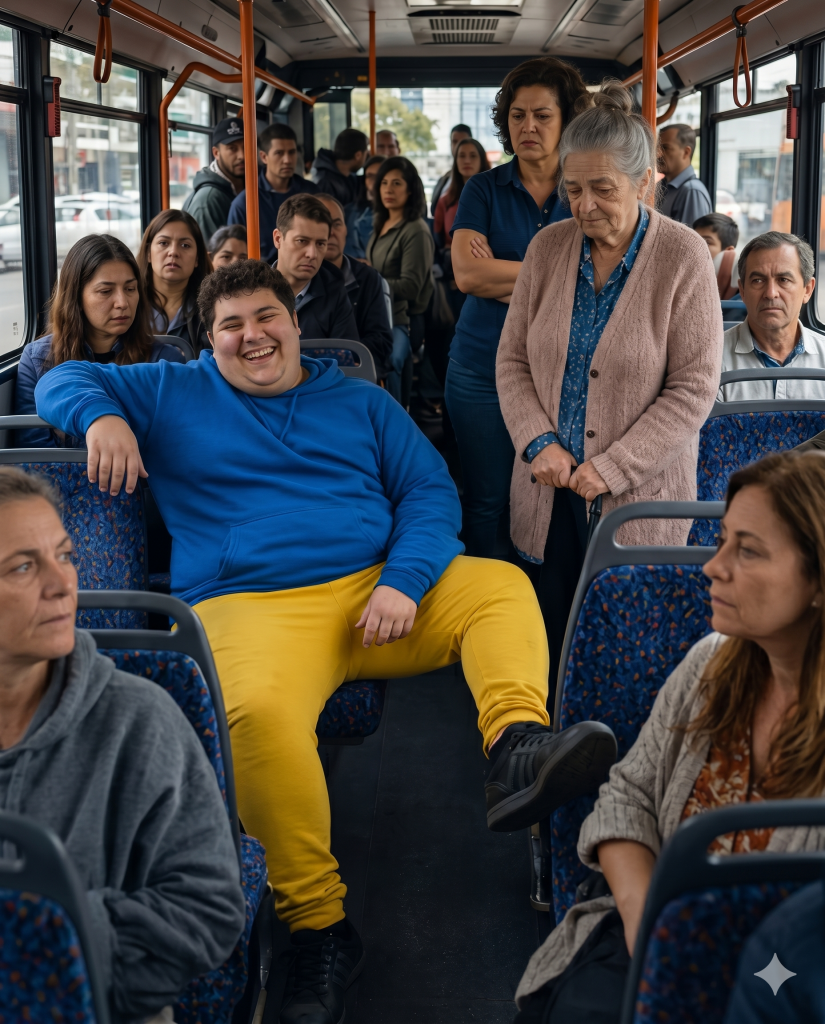
The elderly woman remained standing, her hand gripping the handle of her cane. Her face showed no anger, only quiet disappointment.
Several passengers exchanged uncomfortable glances.
One man shook his head.
A woman near the window muttered something under her breath.
Yet no one said a word.
The young man leaned back confidently.
He appeared pleased with himself.
As if humiliating a fragile old woman in front of strangers was somehow entertaining.
“Find another place,” he said.
“There are plenty of places to stand.”
A few passengers looked away.
Others stared at their phones.
The elderly woman nodded slowly.
“I see.”
Then she carefully stepped aside and continued holding onto a metal pole for support.
The bus pulled away from the stop.
The road ahead was rough and full of sharp turns.
Every movement of the vehicle forced passengers to shift their balance.
The woman struggled to remain upright.
Her arms trembled from the effort.
Yet she remained silent.
The young man occasionally glanced toward her and smirked.
To him, the situation was over.
He had won.
Or so he thought.
Several minutes later, the bus entered a narrow street undergoing construction.
The driver suddenly hit the brakes to avoid a delivery truck that had stopped unexpectedly.
The effect was immediate.
Passengers lurched forward.
Bags slid.
Someone dropped a phone.
And the young man, who had been sitting carelessly with one foot on the seat, lost his balance completely.
His backpack flew from his lap.
His body twisted sideways.
Before he could react, he slammed shoulder-first into the aisle.
The impact was loud enough to draw everyone’s attention.
A few passengers gasped.
Others instinctively stepped back.
The young man cursed and tried to stand.
But the awkward fall had twisted his ankle.
Pain shot through his leg.
He sat back down immediately.
His face turned pale.
The bus continued moving.
Nobody laughed.
Nobody mocked him.
Yet nobody rushed to help either.
The silence felt different now.
Heavy.
Uncomfortable.
Then something unexpected happened.
The elderly woman slowly made her way toward him.
Passengers moved aside to let her pass.
The young man looked up, embarrassed and angry.
What he saw next stunned him.
She offered him her hand.
“Are you hurt?” she asked gently.
The young man stared.
This was the same woman he had humiliated minutes earlier.
The same woman he refused to help.
Yet she was the only person checking whether he was alright.
“I… I’m fine,” he muttered.
But his expression suggested otherwise.
The woman smiled kindly.
“No need to pretend. Pain is pain.”
A passenger finally stood and offered her a seat.
She thanked him and sat down carefully.
Then she looked back at the young man.
“My husband used to tell me something,” she said.
The bus had become so quiet that everyone could hear.
“He said a person’s character appears most clearly when they have the opportunity to be kind and choose not to be.”
The young man’s eyes dropped to the floor.
Nobody said anything.
No lecture was necessary.
No argument.
No shouting.
The truth of her words was enough.
Several stops later, the bus reached the city center.
The young man slowly stood despite his injured ankle.
Before leaving, he turned toward the elderly woman.
For a few seconds, he struggled to find the words.
Then, quietly, he spoke.
“I’m sorry.”
The woman smiled.
A genuine smile.
“Thank you.”
He nodded.
Then added something nobody expected.
“You can have my seat.”
A few passengers chuckled softly.
Even the woman laughed.
“It seems I already do.”
The doors opened.
The young man stepped onto the sidewalk.
As the bus pulled away, he remained standing there, watching it disappear into traffic.
For the first time that day, he looked thoughtful.
Because sometimes the most powerful lesson does not come from punishment.
Sometimes it comes from receiving kindness when you deserve none.
And that is precisely the kind of lesson people never forget.